
Reviewed · TRUJILLO TOURS
Guided Tour of Historic and Monumental Trujillo
Trujillo’s medieval hilltop center packs an impressive amount into a small area. In roughly two hours, you move from the Renaissance arcades of Plaza Mayor to old walls, a Muslim Alcazaba, noble houses, churches, convents, and gates that once controlled access to the town. The setting feels like a film set, but the stones here carry real stories of kings, military orders, and explorers.
I like two things right away: the walk connects major sights instead of treating them as isolated monuments, and the guide points out good places for photographs along the way. Guide Ana, mentioned by name in a detailed five-star review, is praised for making the visit both lively and full of useful comments. The main consideration is pace. With many stops and only about two hours, you will hear more than you can inspect in depth.
Key reasons to consider this Trujillo walk
- Plaza Mayor sets the scene: Begin among Renaissance palaces and the famous equestrian statue of Francisco Pizarro.
- The route reaches the Alcazaba and castle: You get the town’s strongest medieval atmosphere, including old defensive walls and a cistern.
- You see more than the headline monuments: Strong houses, manor homes, church towers, convents, and city gates fill out the story.
- The guide adds themed context: The walk touches on Isabel la Católica, Carlos V, and Spain’s Discoverers.
- Photo advice is built in: The guide recommends especially attractive corners and viewpoints during the route.
- The price is modest: At $13.90 per person, it offers a useful orientation before you explore more on your own.
Starting in Plaza Mayor among Pizarro’s palaces
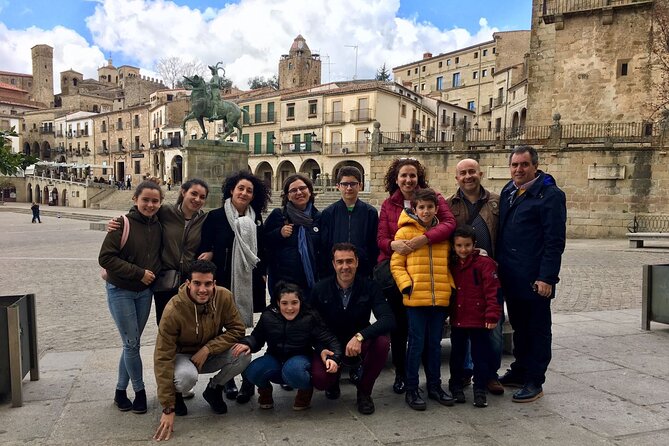
The meeting point is TurismoTrujillo.es Actividades Turísticas at Plaza Mayor, 20. This is a sensible place to begin because Trujillo’s central square gives you an instant lesson in the town’s power and wealth.
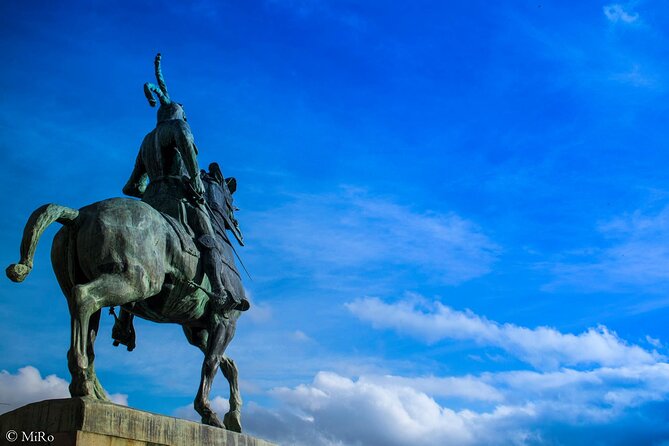
The square is surrounded by Renaissance palaces, with stone façades that make the open space feel grand without losing its village scale. The equestrian monument to Francisco Pizarro occupies a central place in the visual story. Pizarro was the conqueror of Peru, and his connection to Trujillo helps explain why this town produced ambitious figures who reached far beyond Extremadura.
Expect around 20 minutes here at the opening stop, followed by a short explanation of the square’s construction. Work began in 1562 by order of Hernando Pizarro. That detail gives you a useful reminder that the square was not simply an old market area that grew by chance. It was shaped during a period when wealth from Spain’s overseas empire was influencing architecture and public life.
Take a moment to look upward before the group moves on. The façades, balconies, stonework, and statue give you several easy photo subjects. The guide’s suggestions for photographs are especially useful here, since a quick walk through the square can otherwise become a blur of similar-looking palace fronts.
more ancient sites near Trujillo
- Lima’s Vibrant Heritage: Exploring the City’s Landmarks Half-day
★ 4.5 · 581 reviews - Lima: Historic Center Street Food, Market, and Eateries Tour
★ 4.9 · 216 reviews - Walking tour in the Historic Center of Arequipa
★ 4.4 · 180 reviews
The Palacio de San Carlos and the Pizarro connection
The Palacio de San Carlos, also called the Palacio de los Vargas-Carvajal, introduces you to Trujillo’s Plateresque style. Its original façade remains, along with another façade facing Domingo Street.
The stop is brief, about four minutes, so this is mainly a guided look at the exterior and its architectural details. That is not a complaint, but it helps set expectations. You will learn where the building fits into Trujillo’s noble family network, then move on rather than spending time inside.
The nearby Francisco Pizarro equestrian monument receives its own short stop. At about two minutes, the focus is likely the statue’s place in Plaza Mayor and the larger story of Trujillo’s conquistadors. If you want a long treatment of Pizarro’s life, you will need a museum or book later. On this walk, the statue works as a visual marker and a starting point for the town’s links to the Discoverers.
Entering the medieval center and old defensive quarter
The route then turns toward the historic center, where the character of Trujillo changes quickly. The Renaissance polish of Plaza Mayor gives way to stone lanes, defensive walls, strong houses, palaces, churches, and convents.
This is the part I find most useful for first-time visitors. Rather than seeing one monument and leaving, you get a sense of how the town was organized. Fortified residences sit near gates and walls. Religious buildings share space with family palaces. The old center feels layered because each building answered a practical need: defense, worship, administration, or family status.
The route also relates Trujillo to several themed paths. These include the Route of Isabel la Católica, the Route of Carlos V, and the Discoverers routes. The film-stage connection adds another angle, since the medieval streets and fortifications have the sort of setting filmmakers seek.
The tour description gives the historic-center portion a longer time block, while the overall experience lasts about two hours. Read that as a broad route description rather than a promise of two hours at one single monument. The guide is covering a large number of sites, so you should expect concise explanations and frequent movement.
Strong houses and the memory of royal conflict
Casa-Fuerte de Luis de Chaves El Viejo is one of the more distinctive stops. This fortified house dates from the 13th and 14th centuries, and the Catholic Monarchs stayed there during the Wars of Succession.
That single detail changes how you look at the building. It was not merely a grand home. It also served as a defensive residence at a time when noble families needed protection and political alliances mattered. The visit helps you see the difference between a comfortable palace and a house designed to withstand trouble.
You then reach Palacio Viejo, or Palacio de la Cadena, linked to a 13th-century church founded by the Military Order of Santiago. The short five-minute stop connects religion and warfare, two forces that shaped medieval Extremadura. Military orders were not only fighting organizations. They also held land, founded religious sites, and helped control territory.
Since the stops are short, listen for the names and connections that interest you most. You will not retain every date, but you will leave with a better map of Trujillo’s families, orders, and buildings.
more Trujillo days to weigh up
- Guided tour in Trujillo at Sunset “El Collector de Atardeceres”
★ 5.0 · 88 reviews - Guided Walking Tour in Trujillo Through the Centuries
★ 4.5 · 8 reviews - Guided Tours Trujillo Essential
★ 5.0 · 5 reviews - From Lima: Paracas and Huacachina Oasis Full Day Guided Tour
★ 4.7 · 1,780 reviews
Climbing toward Castillo de Trujillo
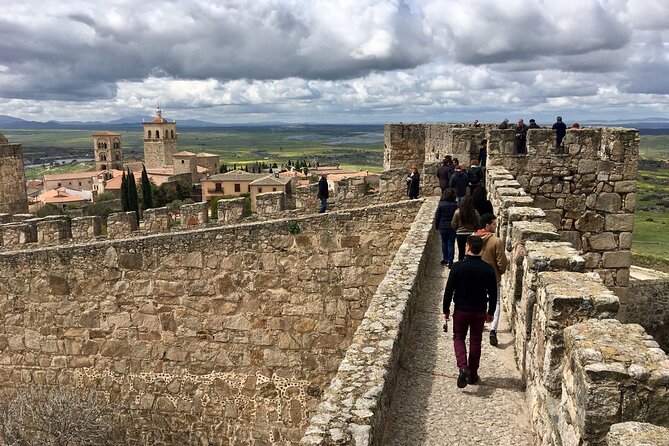
The castle area brings the strongest medieval mood of the tour. Castillo de Trujillo includes a Muslim Alcazaba and cistern dating from the 10th to the 12th centuries, along with the town’s defensive setting.
This is a key reason to book the walk rather than simply wander the center. The guide can connect the castle to the walls and to the town below, showing how Trujillo’s position and fortifications shaped its growth. The Alcazaba reflects the Muslim period, while later Christian buildings and noble residences show how the town changed hands and purpose over time.
The listed stop lasts about ten minutes. That is enough for an introduction and orientation, not a detailed castle study. If the castle is your main reason for visiting, plan to give it extra independent time if possible. The guided route gives you context, but the whole experience is designed to cover the town rather than remain inside the fortress.
The cistern is another useful detail to watch for. Water storage was central to a fortified settlement, especially during a siege. Small practical features like this often make a defensive site easier to understand than dates alone.
Pizarro House Museum and the noble homes of Trujillo
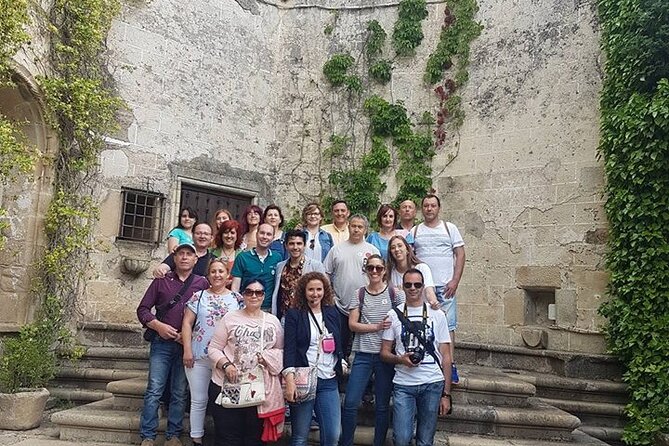
The Pizarro House Museum is described as a 15th-century manor house belonging to a Hidalgo, or member of the lesser nobility. It gives the Pizarro story a more domestic setting after you have seen the public monument in Plaza Mayor.
The difference matters. A statue presents a national or imperial figure. A manor house shows the social world that produced such figures, with family status, local ambition, and inherited connections all tied to the town’s stone buildings.
The stop is listed at about ten minutes. The supplied details do not specify an interior visit or separate museum admission, so treat this part as a guided stop within the route rather than assuming a full museum tour. Your guide will help place the house within Trujillo’s network of noble families.
Santa María la Mayor and the Torre Julia
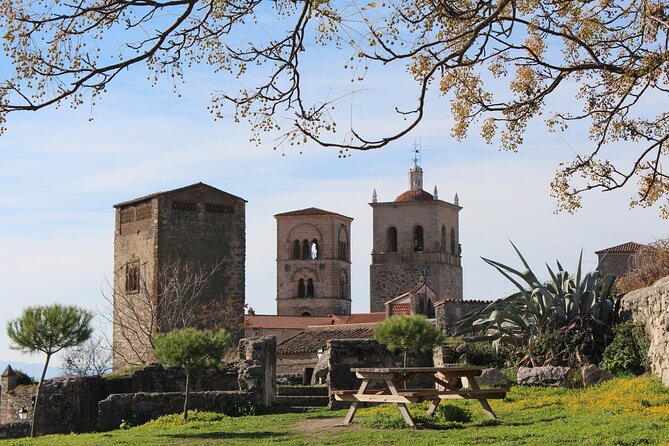
I would pay close attention at Iglesia de Santa María la Mayor. It is a Gothic church declared a National Monument, but it also preserves earlier Romanesque remains, including the Torre Julia.
The Spanish-Flemish altarpiece by Fernando Gallego adds an artistic highlight to the route. This is the kind of stop that keeps the walk from being only about castles and conquistadors. You get architecture, religious history, and a notable work of art in the same place.
The timing is not specified for this stop, so the depth of the explanation may depend on the group and the day. Still, it is worth noting as a place to return to after the tour if you want a closer look. Guided walks are good at telling you what deserves a second visit, and Santa María la Mayor is one of those places.
María de Escobar and the Casa Fuerte de los Escobar
Casa Fuerte de los Escobar brings another personal story into the route. This 15th-century military construction was the home of María de Escobar, identified here as the first woman to bring wheat and barley seeds to Peru.
Her story broadens the usual conquistador narrative. Trujillo’s links with the Americas were not limited to men in military roles. Agricultural knowledge and food crops also traveled across the Atlantic, changing lives on both sides.
The stop lasts about ten minutes. Look for the contrast between the building’s military purpose and the agricultural importance connected to its former resident. It is a small but memorable example of how individual biographies can make a city’s larger story easier to grasp.
Gates, walls, and the final walk through Trujillo
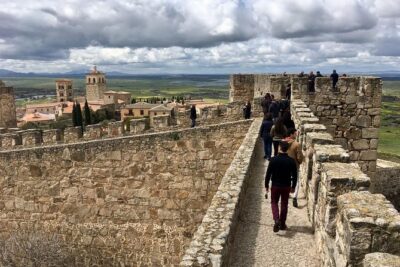
The Triumph Gate and Bejarano Redoubt bring the route back to the town’s defensive edge. The redoubt is a 13th-century strong house that defended the Puerta del Triunfo. Here, the relationship between private buildings and public defenses becomes clear.
A strong house could protect a family, but it could also help guard an entrance. The town’s defenses were not just a wall with a few openings. They were a system of gates, towers, fortified residences, and strategic positions.
The final stop is Puerta de San Andrés, one of the seven gates in Trujillo’s wall, next to the Church of San Andrés. It is a fitting close because gates help you picture daily medieval life. People, goods, soldiers, and news all passed through controlled openings such as this one.
The tour returns to the original meeting point at Plaza Mayor. That makes the route easy to fit into a day of independent sightseeing. You can continue with lunch, return to a church or castle, or use the square as your base for exploring more of Trujillo.
What $13.90 buys you
At $13.90 per person, this is a strong-value orientation walk. Admission is listed as free at the stops, so the fee mainly pays for the guide’s route planning, explanations, historical connections, and help noticing details you could easily miss alone.
Value depends on how you like to sightsee. If you prefer to read every plaque at your own speed, the brisk two-hour format may feel limiting. If you want the town to make sense before exploring independently, the cost is modest for the amount of ground covered.
The group can include up to 30 people. That is not an intimate private walk, and a larger group may make it harder to hear or ask long questions. On the other hand, a capped group gives the provider a clear limit and keeps the outing from becoming an unstructured crowd.
The tour is booked, on average, eight days in advance. That does not guarantee a sellout, but it suggests you should reserve ahead if your schedule in Trujillo is fixed.
Practical details before you go
The experience lasts approximately two hours and uses a mobile ticket. Confirmation arrives at booking, which keeps the basic planning simple.
The start and finish are both at Plaza Mayor, 20, home of TurismoTrujillo.es Actividades Turísticas. The meeting point is near public transportation, and service animals are allowed. The supplied details say most people can participate, but no specific information is provided about pavement, slopes, or wheelchair access, so contact the provider if those points affect your plans.
Free cancellation is available until 24 hours before the start time for a full refund. Cancellations or changes made less than 24 hours ahead are not refunded or accepted, and cut-off times follow local time in Spain.
The experience has a 5 out of 5 rating from 933 reviews, with 100 percent recommending it. The clearest praise focuses on the route being very complete, lively, and full of comments. Ana is specifically praised for leading an engaging and thorough walk through the old center. That is the standard I would hope for from this kind of tour: not a lecture, but a clear story told while the buildings are in front of you.
Who should book this walk?
I would choose this experience if you have limited time in Trujillo, want help sorting the town’s many monuments, or enjoy history presented through buildings and personalities. It is also a good first activity because the guide points out places worth revisiting and suggests useful photo corners.
Families and general sightseers may appreciate the variety. You move from a square to palaces, from a castle to churches, and from walls to gates, so the route does not depend on one long explanation in a single room.
I would be more cautious if you want a slow architectural study, a private guide, or a full interior visit at every stop. The route covers a lot, and some monuments receive only a few minutes. Think of it as a well-planned introduction to Trujillo, not a substitute for every museum and church visit.
Should you book Guided Tour of Historic and Monumental Trujillo?
Book it if you want a compact, low-cost introduction to Trujillo’s medieval center, especially if names, dates, palaces, and fortifications blur together when you explore alone. The combination of Plaza Mayor, Pizarro landmarks, the Alcazaba, Santa María la Mayor, fortified homes, and old gates gives you a strong framework for the rest of your visit.
Skip it only if you already know Trujillo well or want to spend the entire day at your own pace. At $13.90, with a two-hour duration, free cancellation up to 24 hours ahead, and a route that reaches the town’s main historic areas, this is an easy recommendation for most first visits.
FAQ
How long does the tour last?
The tour lasts approximately two hours.
Where does the tour begin?
It begins at TurismoTrujillo.es Actividades Turísticas, Plaza Mayor, 20, 10200 Trujillo, Cáceres, Spain.
Where does the tour end?
The activity ends back at the meeting point in Plaza Mayor.
How much does the tour cost?
The listed price is $13.90 per person.
Is the ticket mobile?
Yes. The experience includes a mobile ticket.
How far in advance is the tour usually booked?
On average, it is booked eight days in advance.
What is the maximum group size?
The tour can have a maximum of 30 participants.
Is admission to the listed stops included?
Admission is listed as free for the stops provided in the tour details.
Can I cancel for a full refund?
Yes. You can cancel at least 24 hours before the start time for a full refund.
Are service animals allowed?
Yes. Service animals are allowed, and the meeting point is near public transportation.
Recently added around Trujillo
- Trujillo: El Brujo Complex Archaeological Tour with Tickets★ 4.6 · 3 reviews
- Chiclayo: Chaparri Ecological Reserve Tour★ 4.8 · 4 reviews
- Guided Tours Trujillo Essential★ 5.0 · 5 reviews
- From Trujillo: Temple of the Moon and Sun and Chan Chan★ 3.3 · 5 reviews
- From Trujillo: Complete full day tour with museums★ 5.0 · 5 reviews
- Guided Walking Tour in Trujillo Through the Centuries★ 4.5 · 8 reviews
- Shore Excursion from Salaverry port★ 4.5 · 8 reviews
- Trujillo Shore Excursion from Salaverry Port★ 5.0 · 9 reviews
Trujillo Tours, compared.
Visit Trujillo Medieval Scene and Route of the Discoverers
Read our review →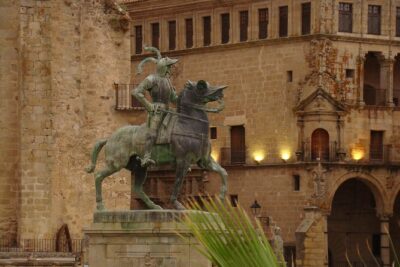
Guided tour in Trujillo at Sunset “El Collector de Atardeceres”
Read our review →
Full Day Tour Huacas, Chan Chan & Huanchaco – Trujillo
Read our review →
Piramids of Tucume Tour, Sican Museum and Lambayeque city tour
Read our review →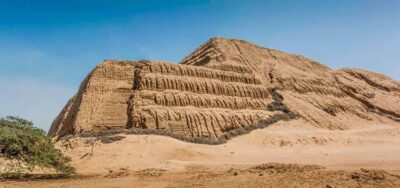
Pyramids of the Sun and the Moon, Huanchaco and Chan Chan
Read our review →Pyramids of the Sun and the Moon, Huanchaco and Chan Chan
Read our review →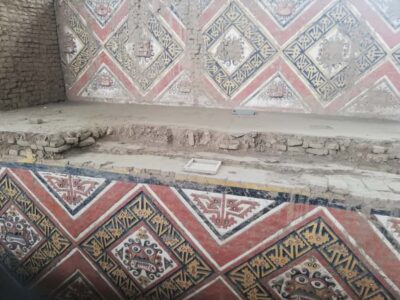
Browse the lists this tour appears in